How Much Can a Chain Hoist Hold? What the Load Rating Really Means
2026-09-09 by Maren Jorgensen
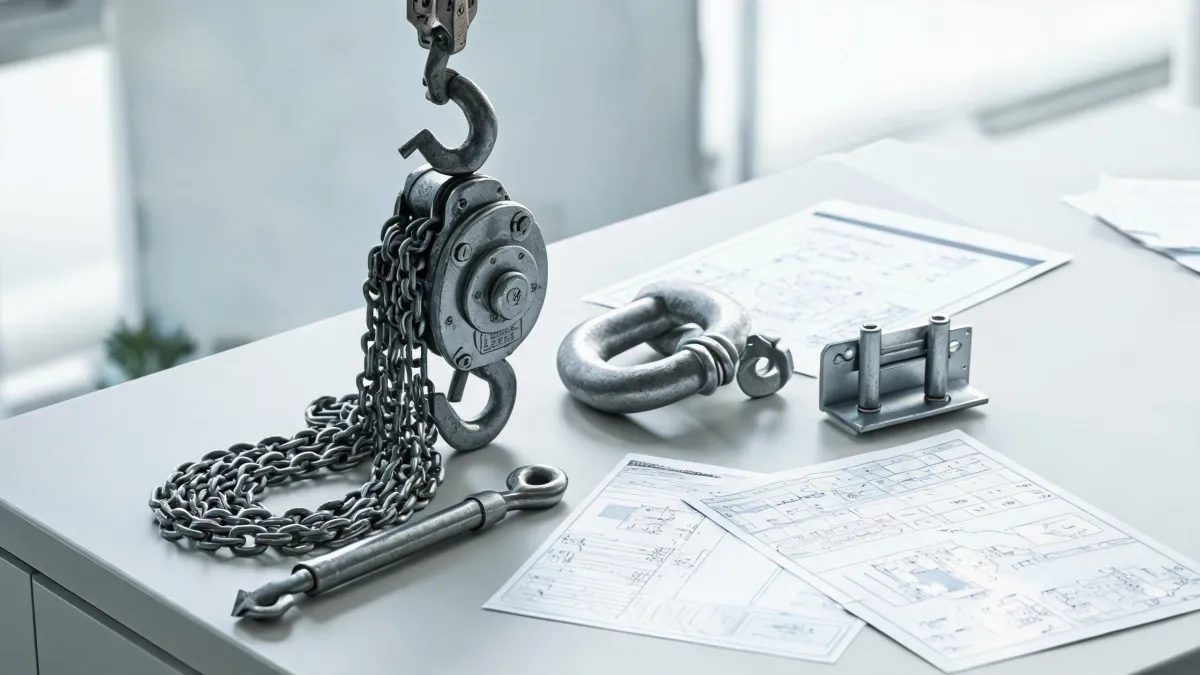
Ask a search engine 'how much can a chain hoist hold' and you'll get a direct answer: a 1-ton hoist lifts 2,000 lb, a 2-ton hoist lifts 4,000 lb, and so on. That's usually all someone wants to hear—until the hoist is hanging, the load is hooked, and the numbers don't feel as simple as they did on the screen. I'm a quality and brand compliance manager at an industrial lifting equipment manufacturer, and I've spent the last four years reviewing hoists, replacement parts, and inspection records. In that time, I've learned that the capacity on the nameplate is a system spec, not a suggestion.
What does 'rated load' actually cover?
A chain hoist is rated for lifting and lowering under controlled conditions. People often ask how much a hoist can hold, but if you need a component to support a load for weeks or months, you need a rated support system, not a hoist brake. A brake is designed to stop a load during operation and keep it in place while the operator pauses. Long-term hanging puts stress on the chain, hooks, and brake and leaves no room for environmental changes. Use load-rated support equipment for long-term suspension.
The load also includes everything below the hook. If a product weighs 1,900 lb and the slings, shackles, and spreader bar add 120 lb, the hoist sees 2,020 lb. I've seen this trip up a crew more than once. In Q1 2024, I reviewed an incident where a 1-ton hoist was used for a load reported as 1,950 lb. The crew had not counted the 85-lb lifting beam below the hook, so the total was above the rated 2,000 lb without anyone realizing it until the inspection.
Where the nameplate answer breaks down
Capacity is the whole assembly, not just the hook
The load path includes the top hook, the chain, the brake, and the lower hook. The weakest component limits the system, and the most commonly overlooked piece is the top hook. In November 2024, I opened a customer-returned 2-ton electric chain hoist and found a top hook that had been replaced at a local shop. The hook looked like the right shape, but it had no grade mark, no capacity stamp, and no way to trace it to a manufacturer. The hoist body was still a 2-ton unit. The suspension point above it had become a guess.
That's why OEM parts matter. If you need a Harrington top hook, order it by model and serial number, not by appearance and hope. The same goes for a clevis, trolley, or suspension lug. A load-bearing part that carries no rating is a red flag, not an upgrade.
For hook inspection, we use the ASME B30.10 criteria. A hook is removed from service if its throat opening has increased by more than 15% or if the hook has twisted more than 10 degrees out of plane from the original. Those limits are useful only when the hook has a known original shape and a verified rating to compare against (Source: ASME B30.10).
Lifting conditions change the force the hoist sees
The rated-load figure is based on a vertical lift with the load centered under the hoist. Off-center lifts, dragging a load, or letting it swing creates extra forces on the chain and brake. Those forces may last only a second, but they can be much higher than the static weight on the hook. If you are anywhere near the rated capacity, that extra force matters.
One number is never the full story
It helps to think about how other shop equipment gets misread. A workshop can buy a MAC5200 3.0 HP air compressor because the horsepower number looks impressive, then discover that CFM at working pressure decides whether an impact wrench keeps running. An older Sears air compressor can have a large tank and still be wrong for the job if the pump cannot keep up at the required duty cycle. The same thing happens with hoists. A thick chain or a big hook can look capable, but the rating is the result of a complete design—not a single visible component.
What ignoring the system rating costs
Here's the pattern I keep running into: a facility buys one or two hoists from a known manufacturer, then adds a third from a low-price listing because the nameplate says the same capacity. The first two have manuals, part breakdowns, and stamped ratings on load-bearing components. The third has a sales photo. When something fails on the third, there is no part number, no manual, and no one to ask. The savings disappear in the first repair.
In a 2023 purchasing review, we compared replacement hooks from three suppliers who all claimed to meet the same drawing. The cheapest bid was about 38% below the highest. The samples looked acceptable, but the low-cost supplier could not provide heat-treat certificates showing the hook steel was processed consistently. A 38% saving on one part suddenly does not sound like a bargain if a hook failure drops a load. That is the kind of calculation that should drive buying decisions.
How to make the capacity question useful
Instead of stopping at 'how much can a chain hoist hold,' ask what the hoist is rated for in the specific way you plan to use it. The answer changes when you add rigging weight, side pulls, or a worn brake.
- Weigh the heaviest real-world load, including all rigging and attachments.
- Round up to the next capacity class when the load is close to a rating boundary.
- Confirm the data tag, hook stamps, and chain markings match the manufacturer's documentation.
- Inspect hooks, chain, brake, and suspension according to ASME B30.10 and B30.16 criteria before putting the hoist into service.
- Keep spare parts traceable. A manual or electric Harrington chain hoist has published specs from 1/4 ton up to 5 tons, with replacement top hooks and load chains listed by model.
In my experience, the extra cost of a larger-capacity hoist is almost always cheaper than the cost of a dropped load. That does not mean over-buying; it means buying the right spec and leaving a small margin for real-world conditions.
So, to answer the literal question: a properly rated 1-ton chain hoist can lift 2,000 lb, but only when the hoist is complete, the load is rigged vertically, and the unit is in good condition. The real answer includes the components below the hook, the inspection history above it, and the margin you leave for the unexpected. That is the difference between reading a nameplate and managing a load.

Maren Jorgensen
Maren Jorgensen is an independent hand tool and torque applications analyst covering wrenches, pliers, screwdrivers, hammers, sockets, ratchets, hex keys, and tool sets. She applies ISO 6789-1 torque-tool conformance principles while examining jaw capacity, leverage, fastener engagement, torque range, accuracy, handle geometry, and material hardness. Her practical guides help tradespeople and procurement teams select suitable tools, plan controlled tightening, and compare durability without relying on brand reputation alone.