Which Harrington Are You Looking For? A Procurement Guide for Hoists, Plastics, and Hardware Parts
2026-09-29 by Rajiv Menon
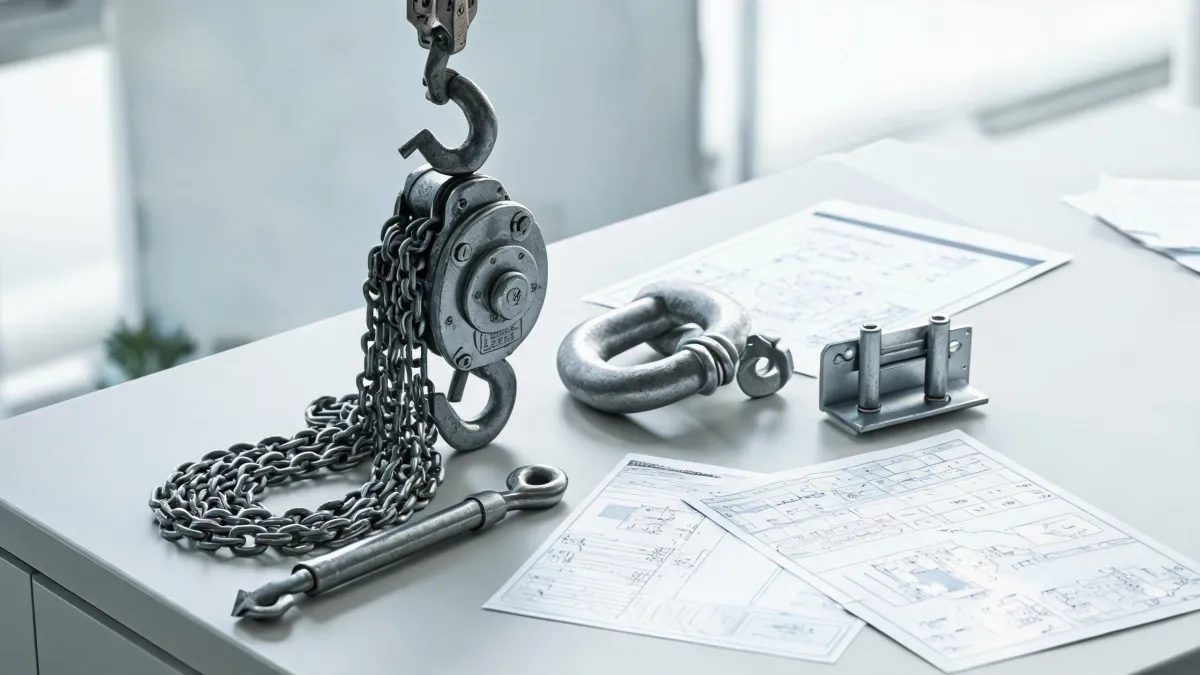
Which Harrington Are You Actually Looking For?
There's no single answer to a search for harrington. I know because I manage MRO and facilities purchasing for a 180-person fabrication shop. I handle roughly $220K annually across 14 vendors, and I report to both operations and finance. That means my inbox gets requests that sound identical but belong in completely different supply chains: a maintenance tech wants a hoist chain, a facility manager asks about garage door repair in Harrington Park NJ, someone in the shop needs 140 welder parts, and the front office wants a thin door hinge for a display cabinet.
Same word. Different problems. If you order the wrong thing, you do not just waste money. You waste a week, you look bad to your internal customer, and finance asks why the PO does not match the invoice.
I am not a rigging engineer, so I cannot speak to load ratings or structural safety. What I can tell you from a procurement perspective is how to route the request, what to verify before you buy, and when to stop DIY-ing.
The First Split: Brand, Place, or Generic Hardware
Most confusing searches come down to one question: are you looking for a company, a location, or a part? Once you separate those, the buying path gets clearer.
Scenario A: You need Harrington hoists or hoist parts
If the request includes a capacity like 1/4 ton, 1 ton, or 5 ton, and it says manual or electric chain hoist, you are probably looking for Harrington Hoists. That is the lifting equipment brand, not a local repair shop and not a plastics supplier.
Before you order anything, get the data plate info. Model number, serial number, capacity, and voltage if it is electric. Harrington makes manual and electric chain hoists across a wide capacity range, and they also supply manuals and replacement parts. But parts are not universal. A brake for a 2-ton electric hoist will not fit a 1/2-ton manual unit.
I went back and forth between OEM and aftermarket hoist parts for two weeks. The aftermarket option was cheaper and available faster (surprise, surprise). The OEM option had the exact spec and a traceable invoice. I ultimately chose OEM because the hoist was in a production area and the risk was not worth the savings. That is not a rule for every part. Consumables are different. But for load-bearing components, I do not gamble.
According to ASME B30.16, overhead hoists are subject to inspection and maintenance requirements. Your vendor should be able to provide documentation. If you are buying from a random marketplace seller, ask yourself who you will call when the part does not fit or the paperwork is missing. Also: never approve a part that claims capacity beyond the original rating. The rated load is the rated load.
For us, the reliable path is an authorized distributor who can match the serial number and provide a proper invoice. That invoice matters. In 2022, I tried a new vendor that was 20% cheaper. They sent a handwritten receipt. Finance rejected the expense. I ate $2,400 from my department budget. Now I verify invoicing before I place any order.
Scenario B: You need Harrington Industrial Plastics
Then there is harrington industrial plastics. That is a different company. They focus on industrial plastics: piping, valves, tanks, fittings, corrosion-resistant systems. If your maintenance team is asking for PVC, CPVC, PTFE, or plastic piping for a chemical line, you are in this scenario.
Do not call a hoist distributor for plastic pipe. And do not expect Harrington Industrial Plastics to have chain hoist brake parts. The names overlap, but the catalogs do not.
For this category, verify material, schedule, size, and pressure rating. A 2-inch PVC schedule 80 fitting is not the same as schedule 40. If the application involves chemicals, temperature, or pressure, get the spec from an engineer. I can only speak to the purchasing side: confirm the part number, the quantity, and whether the vendor can provide material certifications if your process requires them.
Scenario C: You need garage door repair in Harrington Park NJ
If the search is garage door repair harrington park nj, you are not looking for a manufacturer. You are looking for a local service company. That is a different buying decision.
Garage door torsion springs are under high tension. The U.S. Consumer Product Safety Commission (CPSC) has warned that these springs can cause serious injury if handled by untrained people. So I do not let our maintenance team swap springs. We hire a licensed, insured tech.
When I vet a local repair vendor, I ask three things: Are you insured? Can you provide a written invoice and warranty? Do you stock the right springs for the door weight, or are you guessing? A cheap repair that fails in three months makes the facility look bad. And if it is a client-facing building, that matters. The loading dock door is part of your brand whether you like it or not.
Scenario D: You need 140 welder parts
140 welder parts usually points to a welder model, often a 140-amp MIG unit from a major brand. The number 140 is not enough. You need the exact model and serial number. Lincoln, Miller, Hobart, and others have made multiple machines with similar names.
For consumables like tips, nozzles, liners, and drive rolls, aftermarket can be fine if the spec matches. For internal boards, switches, or transformers, I stick with OEM or a reputable repair shop. The wrong board can fry the machine and cost more than the part.
Before you order, pull the parts diagram from the manufacturer's manual. Match the item number, not just the description. If the welder is critical to production, keep a spare liner and tips on the shelf. It is cheaper than a rush shipping charge and a line-down situation.
Scenario E: You need a thin door hinge
A thin door hinge could mean a cabinet hinge, a glass door hinge, or a low-clearance architectural hinge. The word thin is not a specification. Measure the door thickness, the hinge leaf thickness, the knuckle diameter, and the screw hole spacing. If it is for a cabinet, check the overlay. If it is for a glass shower door, see the next section.
This is where a lot of buyers get burned. They search for a thin hinge, find something that looks close, order 20, and then discover the screw holes do not line up. Order one sample first. It costs a few dollars and saves a return cycle.
Scenario F: How to tighten glass shower door hinge
For how to tighten glass shower door hinge, the answer depends on the hinge type. Most glass shower hinges have a set screw or clamp screw that adjusts the door position or tightens the glass clamp. Turn the screw clockwise in small increments, quarter turns. Tighten evenly. If there are two or three screws, do not crank one all the way down and leave the others loose.
Do not over-torque glass clamp bolts. Glass does not deform like wood. It cracks. If you hear creaking or see a chip, stop. I am not a glazier, so I cannot give you a torque spec for every hinge. What I can tell you is that the manufacturer's installation sheet is the only source that matters. If you do not have it, search the hinge brand and model. If the door is sagging, the issue might be the pivot or the wall anchor, not the hinge screw.
How to Tell Which Scenario You Are In
Use this checklist before you create a PO:
- Does the request mention capacity in tons, a data plate, or a chain hoist? You are in the Harrington Hoists scenario. Get model and serial. Use an authorized distributor. Never exceed rated load.
- Does it mention PVC, CPVC, tanks, piping, or chemical resistance? You are in the Harrington Industrial Plastics scenario. Verify material and pressure rating.
- Is the location Harrington Park, NJ? You need local garage door repair. Vet insurance and warranty. Do not DIY torsion springs.
- Is it a welder? You need 140 welder parts. Match the exact model and serial. OEM for critical internals.
- Is it a door, cabinet, or shower? You need a thin door hinge or help tightening a glass shower door hinge. Measure first. Sample first. Follow the hinge manufacturer's instructions.
The common thread is that quality is not just a product feature. It is how your company shows up. When I buy a $12 hinge for a client-facing office door, I am not just buying a hinge. I am buying how that door feels to a customer. When I buy a hoist part, I am buying the confidence that the load stays where it is supposed to stay.
There is something satisfying about closing a PO knowing the part number matches the data plate, the invoice is clean, and the maintenance tech will not be back in my office next week. That is the goal. Not the cheapest order. The right one.
Prices and availability vary by vendor and date. Verify current specs and safety requirements with the manufacturer or a qualified professional.

Rajiv Menon
Rajiv Menon is an independent rigging and lifting hardware analyst covering shackles, chain hoists, hooks, turnbuckles, wire-rope clips, and lifting attachments. He applies ISO 2415:2022 shackle requirements while evaluating working load limit, grade, proof load, design factor, pin fit, sling angle, reeving, brake behavior, identification, inspection, and temperature range. His safety-led guides help lifting teams and purchasers select compatible hardware, interpret markings, establish inspection criteria, and avoid side loading or undocumented substitutions.