The 2 AM Hoist Failure That Changed How I Buy Equipment
2026-08-26 by Maren Jorgensen
The phone rang at 1:47 AM on a Tuesday in March of 2024. I answered because I always answer. It is the rule. My wife has stopped asking why.
"The 2-ton hoist is down," the night shift lead said. No preamble. "It's sitting over a plate on the plasma table. Motor's dead. Load brake held."
I was at the shop by 2:30, which is a personal record, and I started two conversations in my head: the one with the production manager about whether the 6 AM run would happen, and the one with myself about which hoist it was. I already knew the answer, actually. It was the budget hoist. The one I bought six months earlier to save $1,800. The one the maintenance supervisor had politely told me he didn't recommend.
The $1,800 Mistake
The hoist wasn't some no-name overseas brand. It had a logo. It had a website. It even had a warranty. But the motor was cooked, and the "24-hour emergency support" number on their site sent me to voicemail at 3 AM. That was the real price of saving $1,800: a dead motor, a missing support line, and a 20,000-pound steel plate still sitting on the table where my crew was waiting to cut.
I called every parts supplier in a 200-mile radius. One guy in Chicago had a used motor. No warranty, but he'd sell it to me for $450 and guarantee it "probably works." I had a production run worth $47,000 that needed to ship by 2 PM. The customer had a penalty clause at $15,000 per day late. I did not have time to gamble on "probably."
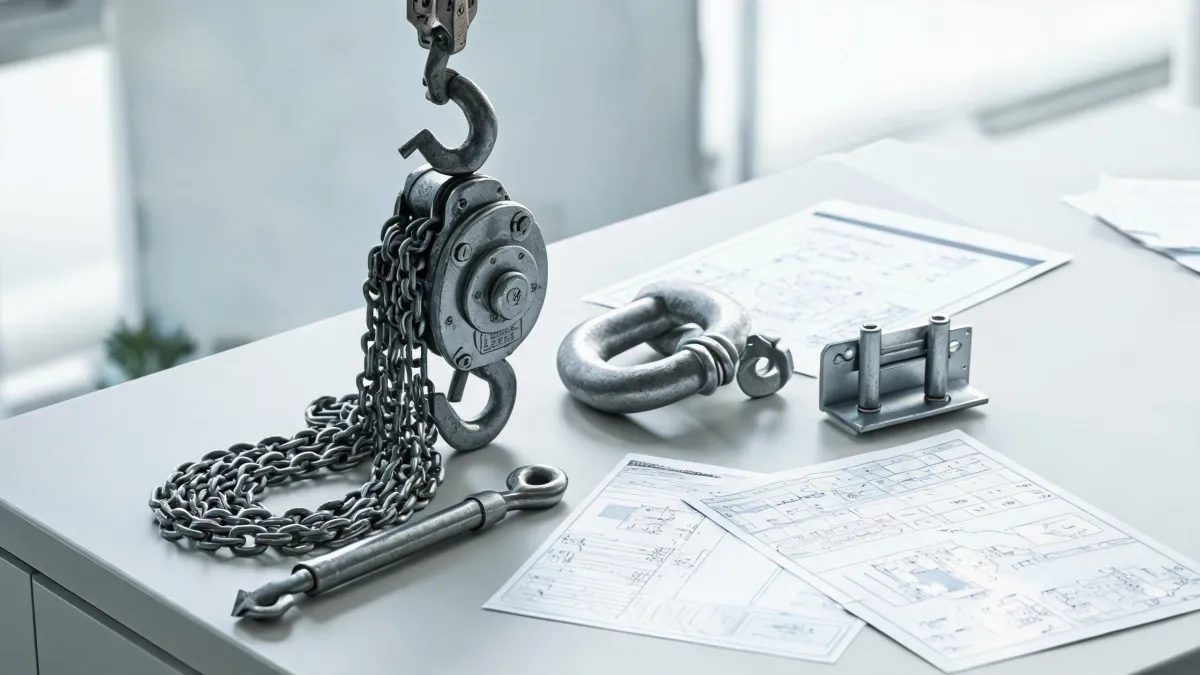
That's when I made the call I should have made seven months earlier: ordered a Harrington electric chain hoist, the 2-ton model, from a distributor in Chicago that actually answered the phone at 3:15 AM. They had it in stock. I sent our own truck to get it. It cost almost $2,400 more than the budget hoist. It was also the easiest purchase decision I've made in six years of doing this job. (Note to self: that sentence is exactly what total cost of ownership is supposed to sound like.)
The Compressor Had Other Plans
While the truck was on its way, the crew started on the mounting bracket. Two bolts on the old hoist had been there since the original install, probably before some of the crew was born. The night lead grabbed the air impact wrench, opened the valve, and the regulator let go. I am not exaggerating: we needed an air compressor regulator repair kit at 4 AM on a Tuesday. I did not have one. The parts store down the road opened at 7. Which is a very long four hours when a $47,000 production run is watching you.
Also, the bracket was cracked. Nobody had caught it. The hoist had likely been straining against it for weeks. That detail becomes important later.
Air vs. Battery Impact Wrench: The 4 AM Test
Let's address the question that probably started a dozen internet arguments: which is better, an air or battery impact wrench?
I've been an air-tool guy my whole career. Air doesn't need charging. Air tools are lighter. Air doesn't lose power in the cold. I have said all of these things, confidently, for years. But at 4 AM, with a frozen compressor and a dead regulator, I reached into my truck and pulled out a DeWalt 20V battery impact wrench that I bought on sale because it seemed like a good idea. It spun those seized bolts off like they were threaded in butter. The battery didn't care about the cold. The battery didn't care that the compressor was down. The battery just worked.
In that moment, the debate was settled for me. It's not about which tool is technically "better." It's about which tool works when everything else has failed. A battery impact wrench is an independent tool. An air impact wrench is part of a system—a system that includes a compressor, a regulator, hoses, and a power supply. If any one of those fails, the air tool is a paperweight with a trigger.
It took me 6 years and about 40 equipment failures to understand that. The $230 battery wrench probably saved us $5,000 in overtime that morning, not to mention the penalty clause.
The Welder We Forgot We Had
The day shift foreman walked in at 6:30, saw the cracked bracket on the floor, and asked, very calmly, "Why didn't you just weld it?"
We'd already sent the bracket to a machine shop for repair at a cost of $980. On the fab bay floor, sitting in plain sight for two years, was a Miller multi handler 200 multiprocess welder—part number 500578, runs on standard 120V power, sells for around $1,200. It could have fixed that bracket in 20 minutes. Probably before the truck got back from Chicago.
I didn't know the welder was there. I've walked past it hundreds of times. It was someone else's domain. That's my fault.
This is the part of the story that bugs me the most, because it's not about a bad product or bad luck. It's about not knowing my own shop's capabilities. If I'd caught the bracket crack during a routine inspection and used the welder, we would have saved $980, avoided a near-miss with a load hanging overhead, and prevented a lot of general misery. The welder was the most capable and the most ignored piece of equipment in the building that night.
What the Harrington Taught Me
The Harrington hoist has been running daily for about 10 months now. Besides routine lubrication, it's needed nothing. The budget hoist needed a limit switch at month four ($180 plus labor) and a new motor at month seven.
But the real difference isn't just reliability. It's the support system. The Harrington came with an actual manual—a printed, spiral-bound manual with part numbers and a wiring diagram. When I called Harrington to verify a load brake spec a few weeks after the install, I got a human on the first ring, and she knew exactly what I was talking about.
That's Harrington hardware at its core: the hoists, the parts catalogs, the support line that answers. You're not just buying lifting equipment. You're buying the ability to fix it, maintain it, and get answers when it matters. And you're buying compliance with something that matters even more—ASME B30.16 covers overhead hoists for a reason, and OSHA expects lifting equipment to be inspected and maintained accordingly. A hoist isn't a consumer product. It's a piece of machinery suspended above people.
I want to say the whole night cost us around $5,000 in direct expenses (new hoist, overtime, freight, bracket repair, regulator repair kit), but I'd have to add it up. The bigger number is the $47,000 order that shipped at 1:58 PM—12 minutes before the penalty clause. That shipment didn't just deliver steel; it delivered the justification for every penny we spent that night.
The TCO Lesson
Conventional wisdom in purchasing says to collect multiple quotes and pick the lowest one. That is how you get exactly what is on the quote, and nothing more.
Total cost of ownership isn't just the invoice. It's the invoice plus the support line that doesn't answer, plus the motor that dies in month seven, plus the production run that almost ships late, plus the $15,000-a-day penalty sitting in the back of your head at 3 AM. The cheapest option was actually the most expensive one by about $6,000—and that's before you put a price on stress.
Our purchasing policy now includes a simple question for any critical equipment: "If this fails at 2 AM on a Tuesday, how much will it cost to fix it?" If we can't answer that with confidence, we buy the Harrington. We buy the battery impact wrench. We keep spare parts in the cabinet. And we make sure someone knows how to use the Miller welder.
As for air vs. battery impact wrenches: buy the battery one first. You'll still want air tools later, but on the night when the compressor is frozen and the regulator is shot, a battery wrench is the difference between fixing the problem and standing around waiting. (Note to self: check whether the DeWalt warranty covers dropping it off a scissor lift.)
That's the story. It's not glamorous, but it's real. And if you're the person making equipment decisions at your shop, think about the 2 AM test before you sign the PO. The $47,000 lesson is a really expensive way to learn about total cost of ownership.

Maren Jorgensen
Maren Jorgensen is an independent hand tool and torque applications analyst covering wrenches, pliers, screwdrivers, hammers, sockets, ratchets, hex keys, and tool sets. She applies ISO 6789-1 torque-tool conformance principles while examining jaw capacity, leverage, fastener engagement, torque range, accuracy, handle geometry, and material hardness. Her practical guides help tradespeople and procurement teams select suitable tools, plan controlled tightening, and compare durability without relying on brand reputation alone.