The Cheapest Harrington Chain Hoist Quote Is Almost Never Your Best Deal
2026-10-08 by Darius Campbell
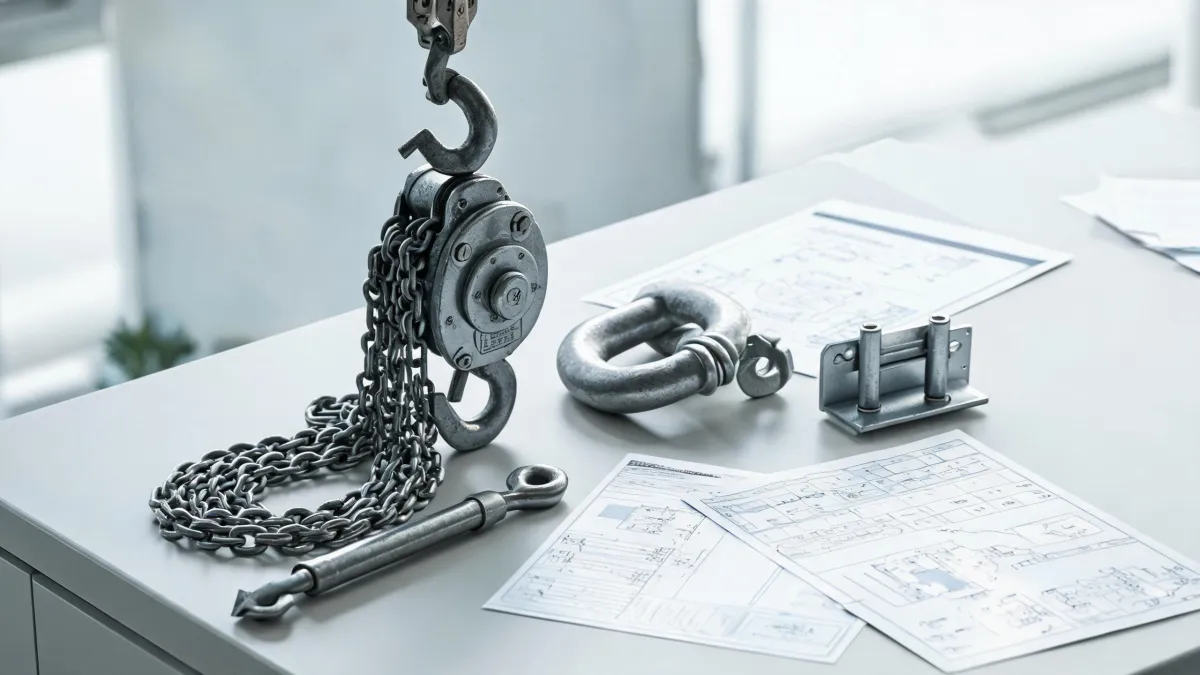
I'll say it plainly: the lowest quote is almost never the cheapest option
If you're buying Harrington chain hoists based on unit price alone, I can almost guarantee you're paying more than you think. Not in theory—in practice. I've watched it happen across hundreds of orders.
I'm a quality and brand compliance manager at an industrial supply company. I review every hoist order before it ships to our customers—roughly 300+ items a year. Last year, I rejected 12% of first deliveries due to spec mismatches. Every rejected batch has a cost story nobody put on the quote sheet.
Argument 1: The number on the quote isn't the price you pay
When a distributor quotes you a Harrington 2 ton chain hoist manual unit, here's what's typically not in that number:
- Freight. These things are heavy. Shipping isn't trivial.
- Replacement parts. Chains, hooks, brake components—they wear out. Is that in your budget?
- Documentation and compliance paperwork. The harrington 2 ton chain hoist manual itself is a signal—it tells you whether the supplier actually has their act together.
- Warranty response time. If something fails, how fast do they move?
Here's what happened to us: we calculated that a supplier quoting $60 less per unit actually cost us $180 more per unit over three months—once we factored in freight, the administrative cost of missing certification documents, and expedited replacement parts. That "cheaper" quote was a net loss.
Bottom line: the quote is just the entrance fee.
Argument 2: The batch that changed how I think about pricing
The vendor failure in early 2023 completely changed how I evaluate hoist suppliers. We received 40 manual units where the nameplate capacity didn't match the certificates. Not a huge discrepancy—the vendor called it "within industry tolerance." But for our customers, that was a rejection trigger. We sent the whole batch back. They redid it at their cost, but our installation timeline slipped three weeks, and two projects got delayed.
The cost to our company was never on the purchase order. But it was real, and we paid it.
Argument 3: The long game is the only game
I did something last quarter—I put our three-year-old Harrington units side by side with a batch from another supplier. Same specs on paper. But the Harrington batch had original parts manuals for every model, full documentation. The other batch? Nothing. Good luck finding a replacement part.
It's like garage door torsion springs—nobody asks "what is a garage door torsion spring" until the door won't open and they're stuck. By then, you're dependent on whoever picks up the phone, at whatever price they name. You don't want to be in that position with lifting equipment.
I get that buying an impact driver is a different product category entirely—break it, replace it. But hoists? Hoists are safety equipment. The risk profile is completely different. You might find an old welder generator for sale that runs fine at a fraction of retail, but an uncertified hoist is a liability, not a bargain.
"But our budget is tight"
I hear you. I live in budgets too. But budget doesn't mean unit price. Budget means how you allocate what you have.
If you've got $5,000 for five manual hoists, you can spend $4,800 on the cheapest batch and have $200 left for emergencies. Or you can spend $4,700 on compliant units and have $300 left. Either way, you're within budget—the difference is where you're holding the risk.
I've got mixed feelings about the dual-source approach. On one hand, it's more complex. On the other, redundancy saved us during a supply chain disruption last year. We compromise with a primary + backup system, which I'll admit isn't perfect but works.
My position hasn't changed: buy Harrington chain hoists on total cost, not sticker price. Factor in freight, parts, lead time, documentation, and risk. Then decide.
Pricing references are based on our own procurement records and publicly available distributor quotes as of early 2025. Market rates shift; verify before budgeting.

Darius Campbell
Darius Campbell is an independent power tool and cordless systems analyst covering drills, impact drivers, impact wrenches, grinders, circular saws, rotary hammers, and jigsaws. He uses IEC 62841-1 safety requirements while comparing rated input, battery voltage, torque, no-load speed, duty cycle, vibration, dust control, runtime, and accessory compatibility. His evaluation articles help contractors and buyers match tool platforms to workload, mobility, service conditions, and total battery-system cost.