Why Brand Names Alone Don’t Cut It in 2025 MRO Buying
2026-10-08 by Leila Farzan
-
Why Brand Names Alone Don’t Cut It in 2025 MRO Buying
-
Argument 1: Entity confusion is not a minor annoyance. It costs money.
-
Argument 2: The “one vendor for everything” shortcut is breaking down.
-
Argument 3: I only believed the spec-first rule after ignoring it.
-
Argument 4: The data said cheapest. My gut said no.
-
What about the argument that brands are shortcuts for quality?
-
The 2025 approach: verify the entity, the spec, and the parts path
Why Brand Names Alone Don’t Cut It in 2025 MRO Buying
If you’re still buying industrial hardware by brand name alone, you’re running a 2019 purchasing process in a 2025 market. That sounds harsh. I know. I’m an office administrator for a 220-person manufacturing support company. I manage MRO ordering—roughly $380,000 annually across 14 vendors. I report to both operations and finance. And I can tell you: the old shortcut of “buy the familiar logo and move on” is not holding up.
In 2020, I could search for harrington chain hoist parts and get a clean list. Now I get search results mixed with harrington industrial plastics llc, harrington valve, and a dozen other entities that share a name but not a supply lane. The fix is not blind loyalty to a brand. It is verifying the entity, the spec, and the parts path before the PO goes out.
Argument 1: Entity confusion is not a minor annoyance. It costs money.
In 2023, I needed a replacement chain for a Harrington 1-ton manual hoist. I almost approved a quote from a distributor that mostly sells harrington industrial plastics llc products—piping, valves, and related industrial plastics. The quote looked right because the name matched. It wasn’t right. The part would not fit our hoist. I caught it only because the vendor asked for the hoist serial number. That one question saved a $1,100 mistake. Now I verify the manufacturer entity and the exact part number before I sign anything.
harrington valve and Harrington hoists may both show up in the same search, but they are not interchangeable. Neither is every company with “Harrington” in its name. If you do not check, your search results become a trap.
Argument 2: The “one vendor for everything” shortcut is breaking down.
We used to consolidate MRO buying: one fastener vendor, one power tool vendor, one local hardware store. That worked when our needs were simpler. Now our requests look like this: hus ez screw anchor for a concrete install, electric chainsaw parts for the grounds crew, and a maintenance tech asking me how to take a pin out of a door hinge because the procedure actually matters for the repair.
Those are not the same purchase. Not even close. HUS EZ screw anchors are concrete anchors with load data and code requirements. Electric chainsaw parts may be OEM-only or aftermarket, and the wrong bar or sprocket can create a safety issue. A door hinge pin is a maintenance procedure, not a SKU. If I treat all of it as generic hardware, I get wrong parts, delays, and sometimes a safety problem.
So I split the buy by risk. Safety-critical lifting gear gets documentation, traceability, and inspection records. Commodity hardware gets price and speed. The checklist: specs confirmed, timeline agreed, payment terms clear. In that order.
Argument 3: I only believed the spec-first rule after ignoring it.
They warned me to always check specifications before approving. I didn’t listen once. In 2022, I approved a “compatible” electric chainsaw replacement part because the listing said it fit our model. It didn’t. The mounting pattern was off by 4 mm. Cost us $180 and two days of downtime. Not huge. But it was avoidable.
That was a cheap lesson. A wrong hoist part could be worse. A wrong load-rated component is not a spreadsheet problem. It is a safety problem. I should add that our finance team once rejected a $2,400 expense because the vendor gave us a handwritten receipt. So now invoicing capability is part of the spec, too.
Argument 4: The data said cheapest. My gut said no.
Last year, every cost analysis pointed to a budget vendor for a batch of replacement hoist chains. My gut said no. Their quote was 12% lower, but they took four days to answer a basic question about certification. I went with our regular supplier. Later, another buyer told me that budget vendor had shipped the wrong pitch chain twice. Turns out that slow response was a preview of slow delivery.
I am not saying price does not matter. It matters. But the lowest quoted price often is not the lowest total cost. Your time, downtime, and rework are real line items.
What about the argument that brands are shortcuts for quality?
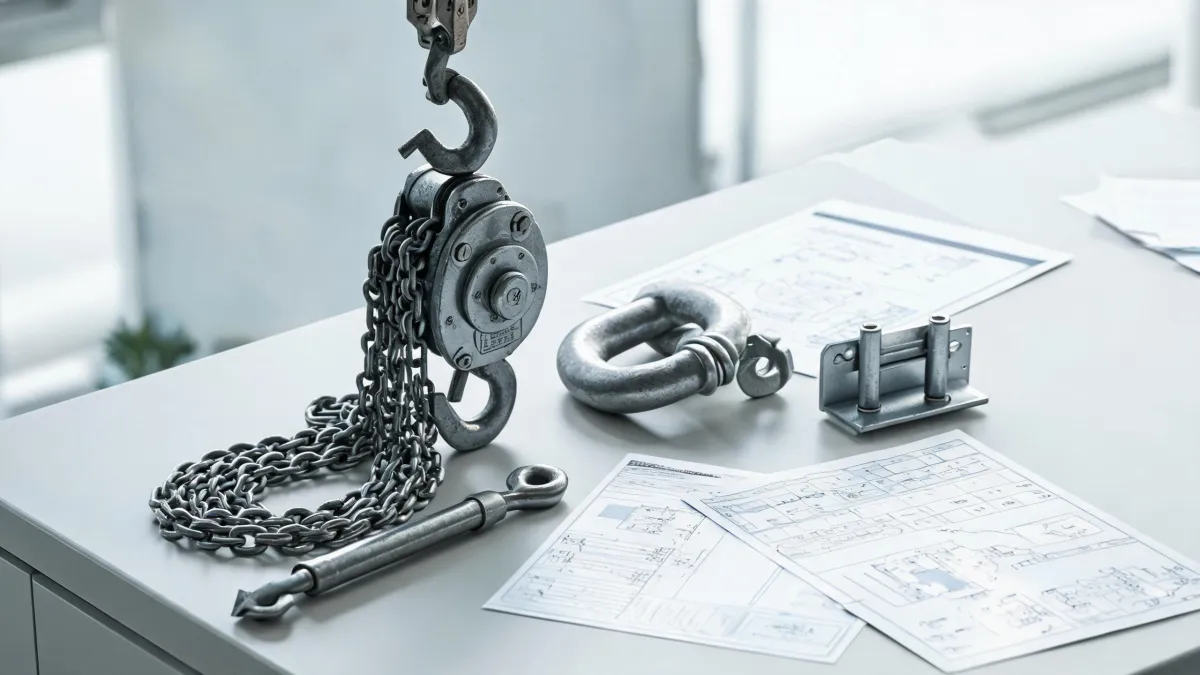
Yes. Brands can be shortcuts. I am not saying ignore them. Harrington hoists have a wide capacity range—1/4 to 5 ton—manual and electric options, plus available manuals and replacement parts. That is exactly why I still specify them for lifting work. But a brand is a starting point, not the whole specification.
Brand is a shortcut. It is not a specification.
The brand name does not tell me whether I need a 1/4-ton or 5-ton unit. It does not tell me if manual or electric is right for the station. It does not tell me whether the replacement part is in stock, whether the vendor can provide a proper invoice, or whether the manual is available. Those details are the purchase.
My experience is based on about 200 mid-size MRO orders in manufacturing and facilities. If you are buying for a large construction fleet or an offshore operation, your documentation needs may be heavier. I can’t speak to that.
Honestly, I am not sure why some vendors can quote a Harrington hoist part in 20 minutes while others take three days. My best guess is they keep better parts databases. If someone has insight, I would love to hear it.
The 2025 approach: verify the entity, the spec, and the parts path
So here is where I land. What was best practice in 2020 may not apply in 2025. The fundamentals have not changed—safety, documentation, and fit still matter. But the execution has transformed. The market is more fragmented. Search results mix unrelated companies. Parts supply is more complex. Procedures are easier to find but easier to get wrong.
Before I approve any MRO order now, I ask:
- Is this the right legal entity and manufacturer?
- Is the part number tied to the exact model and serial number?
- Can the vendor provide the manual, certification, or invoice finance needs?
- Does the lead time match the downtime cost if this fails?
That is more work up front. It saves more work later. If you are still buying by brand name alone, try one order with the full verification. You may find that the familiar logo was never the whole answer.

Leila Farzan
Leila Farzan is an independent welding, abrasives, and cutting accessories analyst covering welders, electrodes, wire, grinding wheels, flap discs, cutting discs, drill bits, saw blades, hole saws, and router bits. She references ISO 525 abrasive-product dimensions and ISO 9606-1 welding qualification concepts while examining wheel speed, grit, bond, electrode class, duty cycle, kerf, tooth geometry, and material compatibility. Her guides help fabricators choose consumables, control process risk, and compare cut or weld quality.