The Real Reason Rush Equipment Orders Fail (It's Usually One Skipped Spec)
2026-09-24 by Koji Sakamoto
The surface problem: you need it now
You get the call at 4:40 p.m. A pump pull is scheduled for 7 a.m. The 3-ton hoist is down. Or a stainless line is leaking, an auction ends tonight on an old welder, and your impact wrench won't break a bolt because the compressor can't keep up. So you open a browser and type things like harrington chain hoist 3 ton, stainless steel ball valves, old welder value, or what size air compressor for air impact wrench. You think the problem is lead time.
It is not. Lead time is just the symptom.
I coordinate emergency orders for an industrial supply company. I have handled 300+ rush orders in nine years, including same-day turnarounds for maintenance and construction clients. When I'm triaging a rush order, I'm not really looking for the fastest SKU. I'm looking for the spec that was skipped.
The deeper problem: you are buying a part, but the system is failing
Most emergency buys fail for the same reason: someone treats a piece of equipment as a single number. A capacity. A size. A price. But industrial gear is a system. The number on the label is only the start.
A hoist is not a capacity number
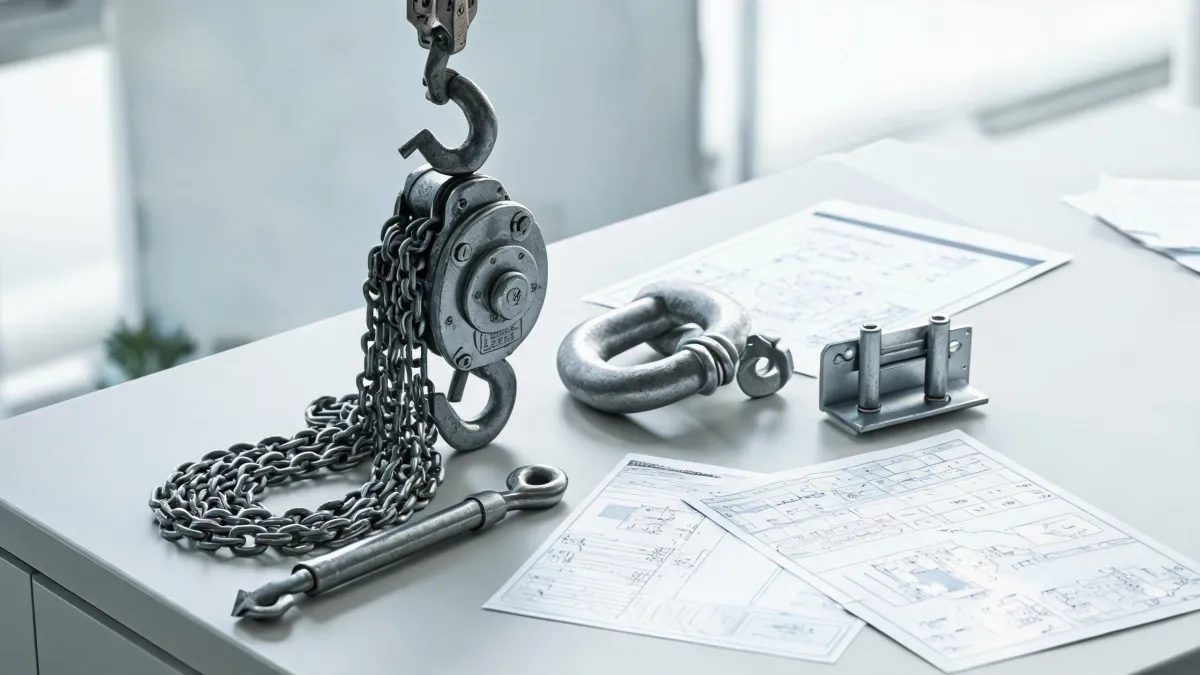
A harrington chain hoist 3 ton is not interchangeable with every other 3-ton hoist. You need lift height. Chain length. Hook opening. Load chain size. Trolley type. Power supply. Duty cycle. Environment. If it is a harrington hand chain hoist, you also need to think about pull chain length, hand chain drop, and whether the operator can actually reach it from a safe position.
ASME B30.16 covers overhead hoists and calls for frequent and periodic inspections of hooks, load chains, brakes, and limit devices. That standard does not care that your deadline is tomorrow. If you buy the wrong hoist, you do not get a fast fix. You get a second problem.
ASME B30.16 exists because hoists are load-bearing equipment. A missed spec is not a paperwork issue. It is a safety issue.
And never assume a hoist can do more than its rated capacity. A 3-ton Harrington is a 3-ton hoist. It is not a 3.5-ton hoist because the crew is in a hurry.
Stainless steel ball valves are a chemistry and pressure question
The same pattern shows up with stainless steel ball valves. People search by size and material, then buy. But a valve is a pressure boundary. You need media, temperature, pressure class, end connections, seat material, body style, and actuation. Per ASME B16.34, pressure-temperature ratings are not universal. A valve that is fine for water at 100 psi might be wrong for steam, caustic, or a different temperature.
If you skip that, the leak does not stop. It moves.
Old welder value is not a blue-book number
Then there is old welder value. This one is pretty messy. Honestly, I'm not sure why old welder values swing so wildly. My best guess is it comes down to duty cycle, amperage, leads, gun condition, voltage, and whether the brand still supports parts. A clean-looking unit with a fried board can be worth less than scrap. An ugly unit with good copper and a known repair path can be worth real money.
Take this with a grain of salt: if you are buying a used welder for a deadline, assume it needs a service check before it earns its keep. The purchase price is not the cost. The cost is purchase plus repair plus downtime.
Air compressor size for an impact wrench is not tank gallons
And what size air compressor for air impact wrench is probably the most common rushed mistake I see. People buy a compressor by tank size. That is sort of like buying a truck by the size of the fuel tank. What matters is airflow. Your impact wrench needs a certain CFM at 90 psi. If the compressor cannot deliver that, the tool will slow down, stall, or wear out faster.
Check the tool manual. It will list CFM at 90 psi, not just maximum pressure. Plus, a long, narrow hose can knock down performance. A small pancake compressor might run a nailer. It will not keep up with a 1/2-inch impact wrench on a rusty bolt.
What guessing costs
The bill for a skipped spec rarely shows up on the first invoice. It shows up later.
In March 2024, a plant called at 4:40 p.m. needing a harrington chain hoist 3 ton for a pump pull the next morning. Normal lead time was two days. We found one at a nearby distributor, paid $240 extra in freight, and delivered by 7 a.m. The client's alternative was pushing a shutdown that cost about $9,000 per shift. The rush fee was annoying. The delay would have been worse.
But I have also seen the other side. The upside was $600 in savings on a used hoist. The risk was a brake that might slip under load. I kept asking myself: is $600 worth potentially putting a crew under a suspended load? That is not a close call. That is a hard no.
So the real cost of guessing is not just the return freight. It is the second order, the second install, the rented backup, the missed window, and the safety exposure. A five-minute verification is cheap. A five-day correction is not.
The short fix: verify before you buy
I am not going to pretend this is complicated. It is not. But it does require you to stop before you click buy.
- Confirm the true load. Not the catalog number. The actual weight, plus rigging, plus any dynamic factor.
- Confirm the physical fit. Lift height, chain length, hook opening, mounting, trolley, and reach.
- Confirm the power and duty. Manual or electric, voltage, plug, control pendant, duty cycle, and environment.
- Confirm the valve spec. Media, temperature, pressure class, end connection, seat, and actuator.
- Confirm the welder spec. Amperage, duty cycle, input voltage, leads, gun, and parts availability.
- Confirm the air spec. CFM at 90 psi, tank size, hose ID, and run time.
- Confirm manuals and parts. If it breaks, can you get the right replacement?
For Harrington, the good news is that the line covers a wide capacity range, manual and electric options, and available manuals and replacement parts. But that does not remove your responsibility to match the hoist to the job. The brand helps. The spec still decides.
Bottom line
The emergency is real. The mistake is optional. Whether you are buying a harrington hand chain hoist, a stainless ball valve, a used welder, or sizing a compressor for an impact wrench, the pattern is the same: the fast answer is usually the wrong answer unless you check the system first.
Five minutes of verification beats five days of correction.

Koji Sakamoto
Koji Sakamoto is an independent pneumatic tool and compressor analyst covering air compressors, impact wrenches, air ratchets, nail guns, and general air-tool systems. He applies ISO 11148 safety requirements while evaluating working pressure, free-air delivery, air consumption, hose loss, duty cycle, fastener capacity, vibration, noise, lubrication, and moisture control. His application guides help workshops and contractors size air supplies, compare tool output, and prevent performance losses caused by undersized or poorly maintained systems.