Why I Read the Harrington 2-Ton Chain Hoist Manual After It Was Too Late
2026-09-03 by Maren Jorgensen
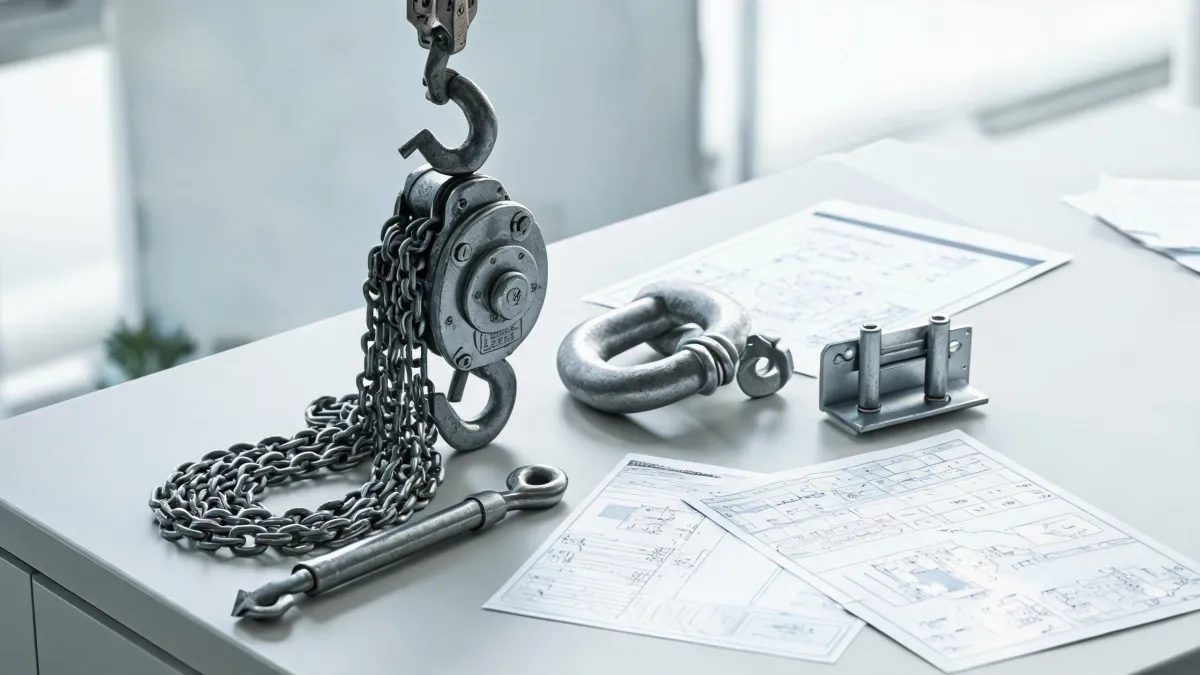
Last fall, I stood in Bay 3 with a new Harrington 2-ton chain hoist hanging from a trolley. I pulled the hand chain, and the load hook traveled down a few feet—then stopped. The chain had reached the end of its rated lift, and the hook was still too high to reach the lifting eye on the fixture below.
Some purchases are easy. Earlier in the week I had opened an air compressor catalogue, matched a part number, and ordered a replacement part. That is order entry, not equipment selection. A chain hoist is different, though it doesn't look different when you shop online.
What I Missed in the Harrington Catalog
Our Bay 3 has an overhead trolley beam that we use for lifting motors and pumps onto repair stands. The old hoist was rated for 1 ton, but one of the pumps we needed to handle weighed about 2,300 lb. I opened the Harrington catalog and filtered for 2-ton manual chain hoists.
The catalog showed a 2-ton manual unit with either a 10-foot or a 20-foot standard lift. The 10-foot version was in stock. I chose it because 10 feet sounds like a lot of reach, and I didn't want to wait for the longer option. Two days later, it arrived, and we hung it on the trolley.
When I tried to lower the hook to the pump lifting eye, it stopped about 18 inches too high. At first I thought the chain was tangled. It wasn't. The load chain had simply reached the end of its useful travel. The unit was working exactly as specified. I had specified the wrong lift.
What the Manual Taught Me
I went back to the product page, still convinced I had missed something. Then I found the Harrington 2-ton chain hoist manual and read the section on dimensions and hook travel.
The manual made it clear: the rated lift is the maximum distance the lower hook can travel downward from its highest working position. It is not the distance from the hook to the floor. It is not the length of the hoist body. It is hook travel. In our setup, the load hook's highest position starts below the trolley and hoist body, so I could not just compare the lift number to the height of the beam.
The catalog told me that the capacity option existed. The manual told me how to compare that option to my building. Both should have been open before I placed the order.
The exchange cost us around $900 after restocking and freight. Maybe it was $1,050—I don't have the invoice in front of me. It also cost two weeks of Bay 3 not being available for that pump work.
The Pre-Order Checklist I Use Now
After that mistake, I made a simple one-page checklist. It has caught at least four similar mistakes in the past 18 months.
- Before opening a catalog, write down the mounting location and the travel path.
- Measure the distance from the load hook's highest working position to the lowest point you need to reach. Do not estimate this in your head.
- If the hoist will ride on a trolley, confirm the beam flange width and shape are within the trolley range.
- Check the rated capacity against the heaviest real load, and keep a reasonable margin.
- Choose between manual and electric based on frequency and speed of use, not only on budget.
- Download the manual, store it with the model and serial number, and use the parts list for any replacement chain, hook, or trolley.
Use Case First, Brand Second
This sounds obvious, but it is easy to skip when a product category has a strong name. When someone searches "how do you pick a bedroom door lock?" and means "choose one," a proper answer starts with another question: Does that door need privacy or just a latch? A front door lock starts with different questions: security grade, deadbolt, key control, and door thickness.
Chain hoists have the same kind of hidden forks. A 2-ton hook-suspension hoist can be right for one location and wrong for another. A 10-foot lift can be generous in one building and useless in another. The product name is only the beginning.
The Honest Version
I'm not saying my original choice was a bad product. If our load path had been shorter, the 10-foot version would have worked fine. The lesson is not to buy more lift than you think. The lesson is to define the job before you jump to a category.
For overhead lifting, get support from a qualified person if you aren't sure. I'm not an engineer, so I don't give engineering advice. What I can do is keep the manual in the file and make our team use the checklist. Standards like ASME B30.16 and the hoist's own warning tag exist for a reason. They are part of the specification, not just paperwork.

Maren Jorgensen
Maren Jorgensen is an independent hand tool and torque applications analyst covering wrenches, pliers, screwdrivers, hammers, sockets, ratchets, hex keys, and tool sets. She applies ISO 6789-1 torque-tool conformance principles while examining jaw capacity, leverage, fastener engagement, torque range, accuracy, handle geometry, and material hardness. Her practical guides help tradespeople and procurement teams select suitable tools, plan controlled tightening, and compare durability without relying on brand reputation alone.