Why I Standardized on Harrington Chain Hoists After One Brutal February
2026-09-03 by Maren Jorgensen
The loading dock door stopped at three feet at 7:40 a.m. on a Tuesday in February 2025. It was cold enough to see my breath near the dock, and a delivery was due in less than an hour. The door hummed, clicked, and refused to move another inch. That was the opening scene of a two-week stretch that taught me more about maintenance purchasing than the previous five years combined.
Here is the background you need: I'm the office administrator for a mid-sized industrial company in northern New Jersey. Maintenance procurement lands on my desk—roughly $80,000 a year across eight vendors. I report to both operations and finance, so I care just as much about a clean invoice as I do about a facility that actually works.
One Bad Tuesday
When I searched "garage door repair Harrington Park NJ," the first page of results was mostly residential specialists. That was not helpful. Our door is a commercial steel unit with torsion springs, a dock seal, and a safety reverse system. Residential techs do not carry that inventory.
It took two phone calls to find a tech who stocked commercial springs. His price was fair—about $860 for the spring pair, bearings, and labor. The catch was timing: Thursday at 11 a.m., or Tuesday if I paid a 50 percent rush premium. I paid it. The door could not wait. (Mental note: build a list of vetted commercial trades before the next breakdown, not during it.)
From the outside, that looked like an overpriced repair. The reality is that a loading door down during shipping hours would have cost more in delayed deliveries than the premium. Speed was not a luxury; it was the point.
The Air Compressor Made the Point Better Than I Could
The door saga ended, but the following Thursday the shop air went down. The compressor that had run daily since 2014—an Excalibur air compressor, 5 HP, 80-gallon tank—threw an electrical fault that the local motor shop could not troubleshoot without a control board the manufacturer no longer supplied. The OEM had moved on to a newer product line.
The most frustrating part: nobody did anything wrong. You would think a maintenance agreement would catch a failing controller, but the controller gave no warning. The repair quote came back at $1,100 for a used board plus labor. A new equivalent compressor was $2,800 installed.
Part of me wanted to repair it to protect this year's budget. Another part knew that "obsolete" was not going to become "available" later. I approved the replacement. Here is something vendors won't tell you: when a shop quotes a repair on an obsolete part, they are quoting the safe option, not necessarily the smart one. A used board for a 2014 machine was a stopgap, not a solution.
The Inventory Check That Made Us Standardize
While the compressor replacement was being scheduled, the maintenance lead called me into the tool room and opened a drawer. "Can we find a Cyclop ratchet repair kit?" he asked, holding the brake assembly from an old lever puller. We found the parts diagram online, ordered the kit from a rigging supply house in Pennsylvania, and had it two days later for $72. That was the easy part.
That inventory check widened into a review of every piece of lifting hardware in the building. Some of it was for overhead lifting; some of it was for pulling and binding. Our rule is simple: keep those categories separate. The lever puller stays on the pulling side. But even a pulling tool needs a functioning brake and a parts path.
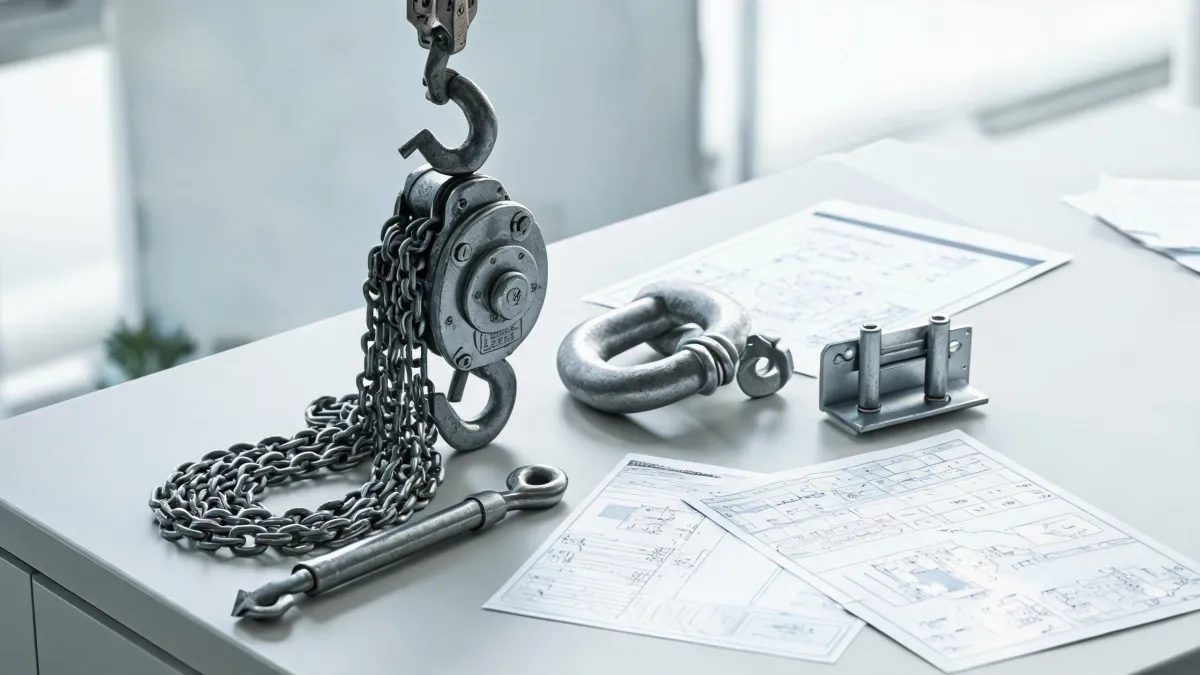
On the beam above the maintenance bay hung a Harrington manual chain hoist that had survived three maintenance managers. Its load chart was still legible. Its manual was in a plastic sleeve. The parts list in the manual matched what our distributor could actually order. That level of documentation felt rare, and it was the reason the maintenance manager stated his new requirement without hesitation: "I want the new ones to be Harrington, same as the old one."
His reasoning was not brand loyalty. It was documentation. When a load is suspended over someone's head, you should be able to identify the part, find the replacement, and confirm the rating. The old Harrington still had all of it. According to the Harrington catalog, the company builds manual and electric chain hoists in capacities from 1/4 ton to 5 ton. For us, that meant one brand could cover manual hoists, electric hoists, and spare parts across the whole site.
Why does that matter? Because every hour spent hunting for a part diagram is an hour of downtime, and downtime is the real cost. We placed the order: one electric chain hoist for the assembly bay, one manual chain hoist for the mezzanine, and a trolley for each.
After I submitted the PO, I second-guessed the lead time. What if the electric hoist did not arrive when the distributor promised? The two weeks until delivery were not relaxing, I admit. The units arrived on schedule, each with a manual and a parts list. I filed both and finally breathed.
Anchors, Stops, and the Valve Question
Installation day came with its own education. Before he would approve the trolley installation, the building engineer asked about end stops on the beam. ASME B30.16, which covers underhung overhead hoists, is one of those standards he keeps on his phone. The product drawings referenced a mounting bracket that the hoist's suspension arms bolt into. I searched "harrington arms anchor" to find the exact kit. It came up immediately: diagram, part number, and torque spec. The anchor kit went on in under half an hour, and the engineer signed off.
The same engineer came back the following week to inspect the heating-water line. He pointed at an old 4-inch valve and said it was the next likely failure. I asked, "What is a double offset butterfly valve?" His answer was the best short version I have heard: "The disc is offset in two planes. When the valve opens, the disc rotates away from the seat instead of scraping across it. Less friction, better seal, longer service life." We were not replacing it that month, but when we do, the spec will be a double offset butterfly valve rather than the unlabeled valve that had been installed years ago.
That conversation was about the same principle as the hoists: when you know the exact component, you can maintain it. When you don't, you get leaks, conflicting advice, and another emergency call.
What the Whole Week Was Really About
By early March, the compressor was running, the loading door opened without drama, both new Harrington chain hoists were mounted with their anchor kits and trolley stops, and the lever puller was back in service with the Cyclop repair kit installed.
I also consolidated the maintenance vendor list from eight to four. Monthly purchasing paperwork went from about eight hours to three. Most important, the emergency search routine has not been needed since.
None of this happened because we bought the fastest solution or the lowest quote. It happened because we picked equipment with a future: manuals, parts diagrams, and supplier support. The things we chose to standardize—lifting equipment especially—were the things that could put someone in the hospital if we guessed wrong.
If you cannot find the parts diagram for something that can hurt somebody, you have not finished buying it.
Look, I'm not saying every purchase needs a research project. But the facilities that recover fastest from breakdowns are the ones that can answer two questions about every critical piece of equipment: What part is this, and where can I get a replacement? In our shop, the answer to the second question is now an easy one: Harrington.
That is not a branding exercise. It's what operating efficiency looks like on a boring Tuesday morning—no breakdowns, no rush premium, no frantic searches. I'll take that over the expensive kind of fast any week.

Maren Jorgensen
Maren Jorgensen is an independent hand tool and torque applications analyst covering wrenches, pliers, screwdrivers, hammers, sockets, ratchets, hex keys, and tool sets. She applies ISO 6789-1 torque-tool conformance principles while examining jaw capacity, leverage, fastener engagement, torque range, accuracy, handle geometry, and material hardness. Her practical guides help tradespeople and procurement teams select suitable tools, plan controlled tightening, and compare durability without relying on brand reputation alone.