Harrington Chain Hoists: A Maintenance Buyer’s Guide to Manual vs. Electric
2026-09-04 by Maren Jorgensen
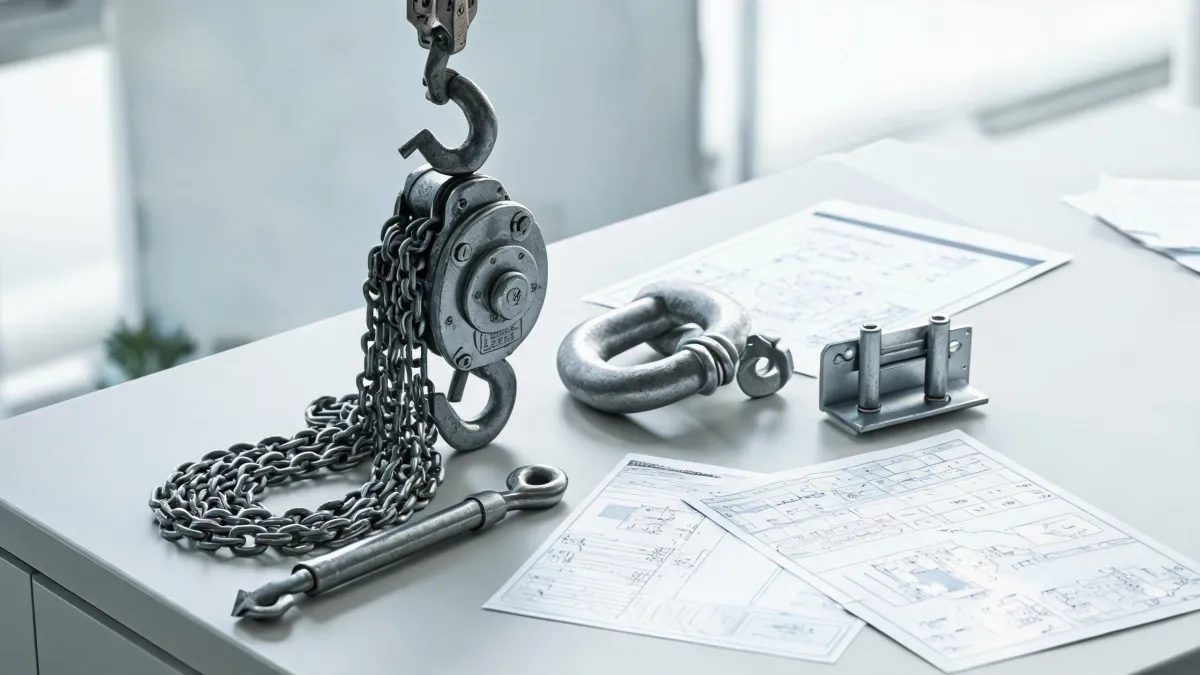
For most plant and facility maintenance work, the right starting point is a 1-ton manual Harrington chain hoist—not an electric one. It handles the loads a maintenance crew actually deals with, doesn’t require an electrician or a new circuit, and is simpler to inspect and store. If the same lift is happening all shift long, buy the electric. But that isn’t how most maintenance departments operate—and it took me a few purchases to learn that.
I’ll put my opinion in context: I’m not an engineer, and I don’t sell lifting equipment. I’m the office administrator for a 140-person manufacturing plant. I’ve handled purchasing for maintenance and facilities since 2020—roughly 60 to 80 orders a year, about $300,000 in annual spend, across maybe 30 vendors. I report to operations and finance, which means I’m the person caught between “we need this by Friday” and “why does it cost so much?” If you’re in a similar role, this article is for you.
Why I Stopped Defaulting to Electric
In 2021, our maintenance lead asked me to get a chain fall for the pump shop. My first instinct was to quote electric models. Electric sounded more professional—faster, easier on the operator, and, honestly, more impressive on a shop floor. I was ready to pull the trigger before I knew how the hoist would actually be used.
The local distributor didn’t just send a price. They asked how many lifts we expected per day. I had no idea, so I asked the crew. Their answer: about five to ten lifts per shift, each one taking only a few minutes. The distributor recommended a 1-ton manual Harrington chain hoist instead of an electric model. I went back and forth for the better part of a week because choosing manual felt like settling. In hindsight, it was the right call. An electric unit would have added a motor, brake, limit switches, and an electrical circuit we didn’t need. The manual hoist has done that job without any trouble since.
Frequency Is the First Question, Not Capacity
People usually ask, “How much weight can it lift?” That matters, but it’s not the first question. The first question is how often the hoist will be used.
A manual chain hoist is built for intermittent work. You pull the hand chain, the load goes up, and then the hoist sits until the next job. That pattern is normal in maintenance. Because it’s fully mechanical, there’s no wiring, no motor starter, and fewer components to inspect when it sits idle for two weeks.
An electric chain hoist has its own strengths. It’s faster and reduces physical effort, and it’s usually rated with a duty cycle—meaning the motor is meant to run for a portion of each hour, not continuously. That rating doesn’t make it better or worse. It makes it more suitable for work where the hoist cycles often enough to justify the added cost and upkeep. If your crew lifts a handful of times per day, an electric unit may spend its life parked.
Honestly, I don’t have hard data on repair frequency across our small fleet. What I can say anecdotally is that the hoists giving us the least trouble are the ones that match their actual workload. That sounds obvious, but I nearly got it wrong because “electric” sounded more advanced.
Four Questions I Ask Before Ordering Any Hoist
If someone says “just get us a hoist,” I now stop and ask four things before requesting a quote:
- What’s the heaviest single thing it will lift? Not the average, but the heaviest pump, motor, or gearbox you can imagine putting under it—plus the rigging. If that number is close to the rated capacity, go up a size. I’d rather explain a slightly bigger purchase than explain an overloaded hoist.
- How high is the beam, and how low does the hook need to reach? I ordered a hoist once with a 10-foot lift for a beam about 18 feet off the floor. After it was hung, the lowest the hook went was around 6 feet—too high to reach a pump sitting on a skid. The exchange cost freight and lost time.
- Does it need to move along the beam? If the hoist will serve several work stations, order it with a trolley so it can travel. A stationary hoist only covers the spot directly below it.
- Who will inspect it, and where are the manual and parts list? In our building, hoists are treated as safety equipment. They get inspected on a schedule, and inspections find wear items like chain, hooks, and brake parts. If I can’t get a manual or a parts diagram for the unit, I don’t buy it.
Parts, Documentation, and Small Orders
This is where the brand comparison became concrete for me, and it’s not about a magazine spec sheet. Harrington’s product line covers manual and electric chain hoists from 1/4 ton to 5 tons. What matters more to me is that replacement parts and manuals are available without a scavenger hunt. When the maintenance team asks for a replacement hand chain or a hook latch, I want to find the part number and order it. I don’t want to hear that the model was discontinued and the closest option is “try eBay.”
We’re also a small account. We order one or two hoists at a time, and sometimes nothing for two years. Some vendors let you feel that. The distributor we use treats a single-hoist order like a real request—they ask for the nameplate information, confirm the application, and send a proper quote. For an administrator whose finance team expects clean paperwork, that level of service is as valuable as the product itself. The suppliers who treat small orders well are the ones I remember when a bigger need comes up.
When I Would Order the Electric Model Instead
I don’t want this read as “manual forever.” In our production area, we have a line that handles the same subassembly repeatedly throughout a shift. For that spot, I ordered a Harrington electric chain hoist. A manual unit would have slowed the line and been hard on the operator. The electric hoist was worth every dollar there.
If your situation looks like that—frequent lifts, limited time between cycles, or a physically demanding lift height—an electric model is the better investment. The same is true if you’re planning for a workstation where the hoist will run most of the day rather than waiting for the occasional repair job.
If you’re not a lifting specialist, you don’t have to navigate this alone. Ask your distributor the four questions above. If they make you feel like the questions are a bother, that’s useful information. The right supplier will want to know the details, because they understand the difference between a purchase that’s cheap and a purchase that’s right.

Maren Jorgensen
Maren Jorgensen is an independent hand tool and torque applications analyst covering wrenches, pliers, screwdrivers, hammers, sockets, ratchets, hex keys, and tool sets. She applies ISO 6789-1 torque-tool conformance principles while examining jaw capacity, leverage, fastener engagement, torque range, accuracy, handle geometry, and material hardness. Her practical guides help tradespeople and procurement teams select suitable tools, plan controlled tightening, and compare durability without relying on brand reputation alone.