Roof Repair with a Harrington Hoist: A Quality Inspector's Jobsight Checklist
2026-09-04 by Maren Jorgensen
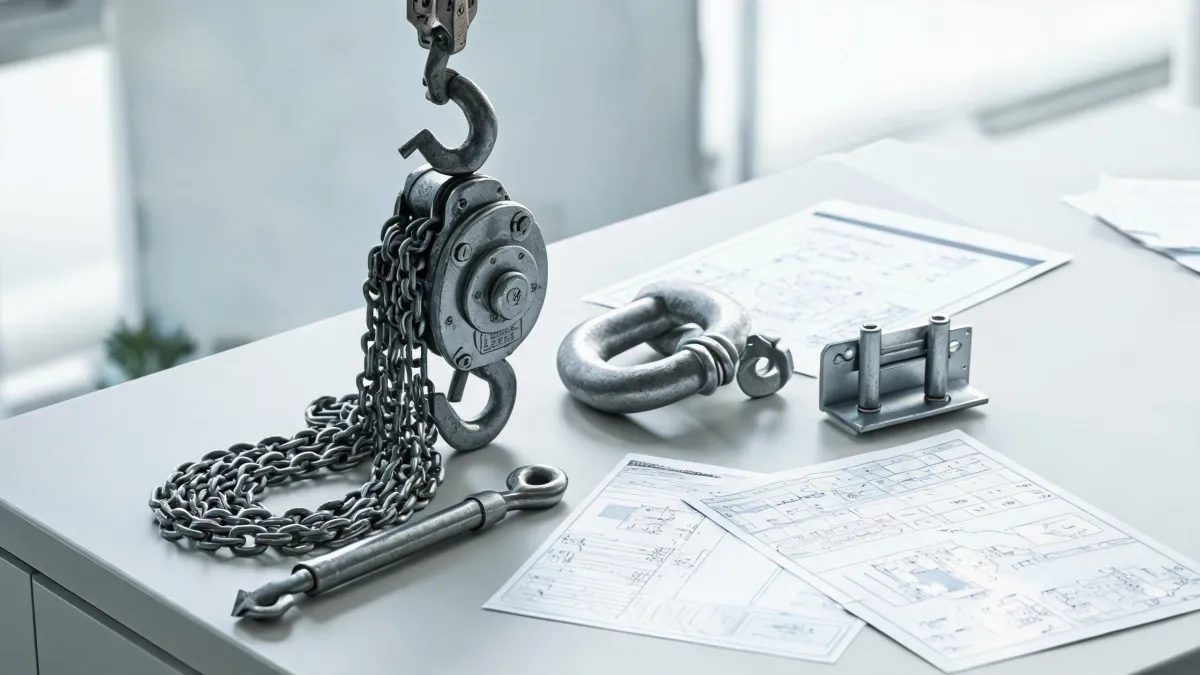
Most roof repair jobs don't go wrong because the hoist suddenly loses capacity. They go wrong in the connections: a stainless steel anchor with no rating mark, an air compressor valve that bleeds pressure overnight, or a cracked plastic chain container that lets the chain cross itself. The hoist can be perfectly rated and the load path can still be unsafe. In my 2024 receiving audits, I rejected about 8% of first deliveries—not because parts were visibly broken, but because material markings or paperwork didn't match the specification.
If you're about to lift roofing materials with a Harrington hoist, check things in this order: hoist nameplate, anchor rating, air supply, then industrial plastic parts. Here's why each one matters.
Why I check the unglamorous stuff
I'm the quality/compliance manager at a lifting equipment and industrial hardware distributor. I review every incoming batch before it goes into inventory—roughly 240 SKUs per quarter. That's not a huge sample, and I've only worked with the suppliers we stock. If you're buying through a different channel, your experience may differ.
In my first year, I made the classic receiving mistake: I trusted a crate label that said stainless steel anchors and skipped the material documentation. The anchors looked fine. The paperwork wasn't even in the crate. We had to reorder everything and inspect the whole lot manually before the customer would accept it. Since we made material traceability a purchase-order condition in 2022, nonconforming receiving shipments have dropped by about a third.
Start with the hoist nameplate
Manual and electric chain hoists both follow one rule: if the nameplate isn't legible, the hoist doesn't go out. Model number, serial number, rated load, and manufacturer all need to match the hoist and the order.
A roof repair crew often uses a Harrington 1-ton manual chain hoist for occasional lifts or a smaller electric chain hoist for repeated lifts. The brand isn't the spec, though. I check the rated load on the tag, then I look at the hook, latch, chain, and limit devices if present. If the nameplate says 1 ton, that's a ceiling, not a suggestion.
I also check the hardware between the hook and the load. A shackle rated for the full load is good, but if the pin is bent or the marking is worn off, it doesn't belong on a roof. Most people inspect the hoist and skip the hardware that actually touches the load.
Stainless steel anchors: rating beats shine
Stainless steel anchors are popular for roof repair because they resist corrosion. But stainless is a family, not a single material. For most inland conditions, 304 stainless is a common choice. In coastal or de-iced environments, 316 offers better pitting resistance. Both can be appropriate. The warning sign is an anchor labeled only as stainless with no grade, no load rating, and no traceability.
These anchors also show up in different forms: expansion anchors, wedge anchors, and threaded studs. The form matters. If the anchor is meant to bite into masonry, the base material and installation torque matter more than the anchor itself. A stainless anchor in a crumbling roof parapet is just a shiny bolt.
If an anchor is part of a lifting or fall-protection system, I need to know its rating and its material. A polished surface doesn't tell me either. That's a counterintuitive lesson from the receiving bay: the shiniest anchor is sometimes the one with the least documentation. For roof anchors that support people rather than equipment, follow the anchor manufacturer's instructions and current OSHA requirements, and verify the setup with a qualified person before the crew relies on it.
Air compressor valve and stem leak check
A roof compressor is easy to ignore because it isn't in the load path. But a leaking air compressor valve makes the unit cycle more often, slows down nailers and staplers, and costs time on a schedule that's already tight. When someone asks me how to check valve stem leak, I tell them to do it before the roof patch is closed up.
How to check valve stem leak
- Let the compressor build to its cut-out pressure, then shut off power.
- Mix a squirt of dish soap with water in a spray bottle.
- Spray the valve stem, valve cap, threads, and the check-valve body.
- Watch for bubbles. A growing bubble is the leak.
If the leak is at a Schrader-style valve core, replace the core with a valve core tool. If the leak is at the compressor check valve, clean and inspect the seat and poppet, then replace worn parts. Don't try to repair a leaking safety valve—replace it. And if the compressor tank itself shows rust or damage, no amount of valve work makes it safe to keep under pressure.
Industrial plastic parts are not automatically the problem
The phrase harrington industrial plastic comes up in parts searches, and I always ask which part is being described. In many hoist designs, industrial plastic parts are intentional: chain containers, covers, and housings made from engineered plastics. They can be lighter and more corrosion-resistant than metal, so plastic isn't automatically a downgrade.
The real question is OEM vs. unknown. If a chain container or cover is cracked, replace it with the manufacturer's part. Don't repair it with epoxy, tape, or a universal bracket. A cracked container might not change the rated load, but it can let the chain tangle or expose moving parts.
Where this checklist stops
This is a receiving and pre-job screen, not a replacement for the manufacturer's periodic inspection or for engineering review. My experience is based on the product families we stock, and I can't speak to custom stainless anchors or specialized compressor configurations. If a lifting point is structural, or if anyone's life depends on an anchor, get qualified help.
If you don't know the rating and condition of every component in the load path, stop. That's the one quality rule I don't bend.

Maren Jorgensen
Maren Jorgensen is an independent hand tool and torque applications analyst covering wrenches, pliers, screwdrivers, hammers, sockets, ratchets, hex keys, and tool sets. She applies ISO 6789-1 torque-tool conformance principles while examining jaw capacity, leverage, fastener engagement, torque range, accuracy, handle geometry, and material hardness. Her practical guides help tradespeople and procurement teams select suitable tools, plan controlled tightening, and compare durability without relying on brand reputation alone.