Why the Harrington Logo Was Not Enough: A Hoist, an Air Compressor Belt, and a Submersible Pump Check Valve
2026-09-10 by Maren Jorgensen
Start With a Hoist That Would Not Lift
Last Tuesday started with an email I never enjoy: Dock hoist down.
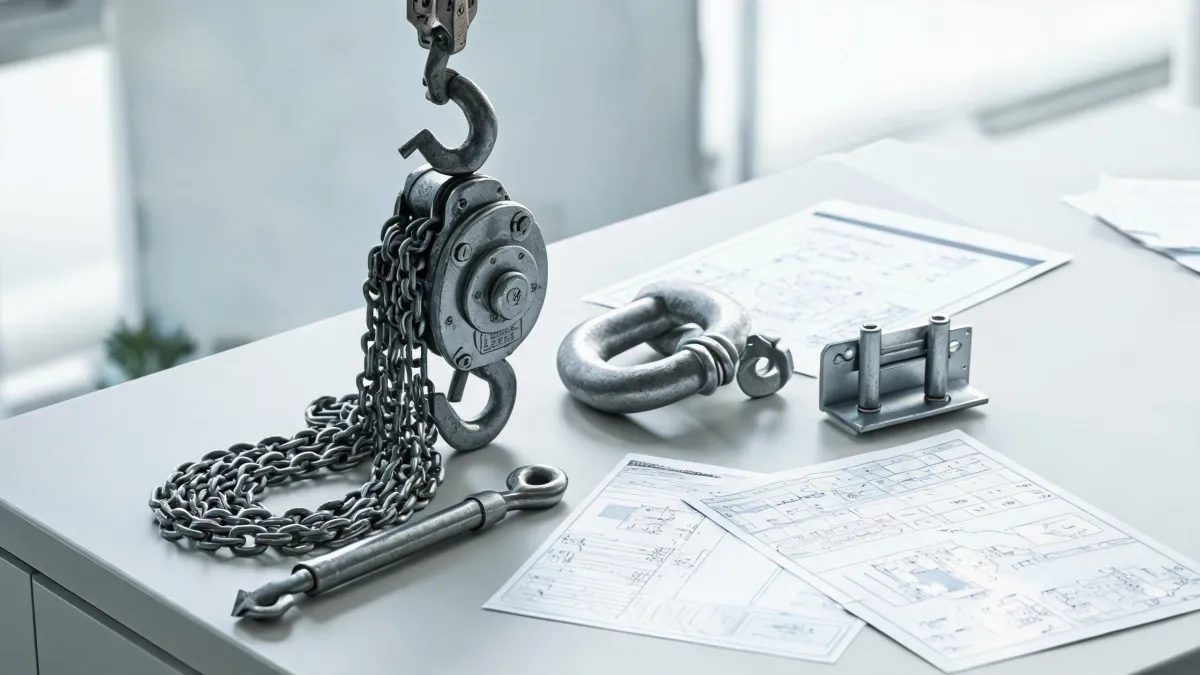
Our loading dock uses a Harrington electric chain hoist, and it gets more action than the maintenance schedule probably likes. The attached photo showed the load chain twisted around itself, with the hook block hanging lower on one side. If you have ever seen a chain hoist in that condition, you already know it is not a minor inconvenience. It is a stop-work moment until someone qualified looks at it.
That someone is not me. I'm an office administrator who handles purchasing for a manufacturer with around 400 employees across three locations. I process somewhere in the 60-to-80 purchase-order range annually. Actually it was 74 last year, but I would have to check, because finance counts tool-on-order differently from maintenance. I answer to operations and finance, which means I care about uptime and I also have to show receipts.
From the outside, a hoist that will not lift looks like a motor failure. The reality is often smaller: a worn brake, a chain that came off the sprocket, or a limit switch that quit. I do not diagnose it. I get the model and serial number to someone who can.
Overhead hoists have their own safety standard, ASME B30.16, and it puts responsibility on the user to keep equipment in safe working condition. In our shop, that means a qualified person has to approve repairs. My job is to make sure that person gets the right part and the right documentation.
'The name on the cover is branding. The name on the plate is engineering,' the maintenance lead said over the phone.
That is why the first thing I ask for is a photo of the full nameplate, not just a photo of the Harrington logo. The logo tells you who made the hoist. The model code tells you which parts manual applies, and the serial number can point to manufacturing changes. If you type Harrington chain hoist parts without those numbers, you get a catalog, but not confidence.
Harrington makes manual and electric chain hoists, from compact 1/4-ton manual models up to 5-ton electric units. That range is useful when different buildings need different capacities. What helps me more, from a purchasing seat, is that replacement parts are published by model and the manuals are still available. That level of documentation is what turned a scary Tuesday into an order I could place with confidence.
One important side note. Searching for Harrington Industrial Plastics Chino CA? That is a different company. The fluid-handling distributor in Chino, CA shares the name but sells pipe, fittings, valves, and related products. The Harrington I deal with builds chain hoists. Same family name, different equipment. The nameplate is the fastest way to tell them apart.
The Same Afternoon Became Three Requests
While I was waiting for the exact model from the dock, the maintenance lead gave me two more jobs. First, he asked for the air compressor belt size for the 36v 2 gal. air compressor in the paint prep room. Second, he asked whether a submersible pump has a check valve. Our yard pump was short-cycling and nobody agreed on whether one was missing.
The three questions sounded unrelated. They were not. All three required the same thing: the exact identity of the equipment, not a general product category.
Start with the belt. I am not a compressor technician, so I cannot name the right belt size from memory. I know enough to know that a belt size is more than a length. You also need the belt profile, meaning the top width and the angle of the V. A 36v 2 gal. air compressor may have a pump that is made by a different company from the badge on the tank. The tank size does not tell you which belt the pump needs. Without the pump model, the old belt markings, or a pulley photo, the responsible answer is, I don't know yet.
That sounds cautious, but I learned it the hard way. The old belt was worn until I could not read the numbers. Instead of waiting for the maintenance lead to pull the pulley and measure the groove, I compared the old belt to an online parts listing for a compressor that looked like the same brand. The new belt was the right length and the wrong profile. When I held the two belts side by side, I finally saw why the cross-section matters as much as the length. The belt sat too deep in the pulley groove and could not grip.
They tell you to write down the stamped code on the belt before you remove it. I only believed that advice after ignoring it. The part itself was not expensive, maybe $14, but with reorder shipping it cost more like $28 and half a day of waiting. Not a huge loss, except the maintenance team was already fighting the down hoist.
Does a Submersible Pump Have a Check Valve?
Now to the question I hear in different forms all the time: does a submersible pump have a check valve? In most installations, yes. A check valve on the discharge line stops water from flowing back into the pit or well when the pump turns off. Without it, the water drains back, and on the next cycle the pump moves the same column of water again. That is the short-cycling we were seeing.
There is some nuance. A submersible pump may have a check valve built into the discharge housing, or it may need one installed in the pipe just above the pump. Some installations also have a check valve higher up. The point is that simply replacing the pump is not enough if the piping is missing the right valve.
I am not a pump engineer, and I will not size one from memory. What I can tell you from a procurement view is that check valves are not universal. You need the pipe size, the valve material, and the type of service. For example, if the pump discharges through 1 1/4-inch pipe, the check valve must match that size and handle the pump flow without being a restriction. If someone asks you only whether a check valve is needed, the practical answer is usually yes. If they ask which one, look at the manual and the pipe.
For our pump, the manual showed an external check valve. When maintenance opened the discharge line, the previous repair had left the valve out. That answered both halves of the question: yes, this submersible pump should have a check valve, and no, the missing valve is why the pump was acting strange. We put the correct replacement valve on the order and scheduled the install.
What the Whole Day Really Taught Me
In the end, the hoist brake part went out for delivery without extra drama. The correct belt was on the way. The pump check valve was confirmed and added to our fluid-handling supplier order. The day looked messy, but the pattern was easy to see. Every problem started with someone describing a product by what it does instead of by its identifying marks.
When I compared the two Harrington hoists in our shop, one with a current model number and one older unit, I understood exactly why customer service keeps asking for the code next to the logo. The logo is a family name. The model and serial number tell you which version of the family you have. Capacity, lifting speed, voltage, and replacement parts can change between serial ranges.
It also reminded me why I stopped trying to shortcut with memory during our 2024 vendor consolidation project. If I type air compressor belt size into a search box without a model number, I get plenty of results, but none are trustworthy for our specific machine. If I ask does a submersible pump have a check valve, I get the general principle, but I still have to check the installation manual to know whether a particular pump needs an integral valve or an external one. The keyword starts the conversation. The nameplate gets the order right.
I don't have hard data on how many extra hours these shortcuts have cost us. Anecdotally, it is more than I want to admit. The wrong belt was not cheap when it had to be ordered twice. The expensive part was not the check valve either. It was the time spent tracing a missing part history on a pump that had been serviced by a previous vendor.
So take it from someone who spends their day pushing paper and making purchase orders: look at the metal tag before you look at the search results. Photograph the model number. Check the old part markings. Read the manual when a pump question feels bigger than your job title. Those extra minutes feel slow, but they are faster than a return label and a second downtime notice.

Maren Jorgensen
Maren Jorgensen is an independent hand tool and torque applications analyst covering wrenches, pliers, screwdrivers, hammers, sockets, ratchets, hex keys, and tool sets. She applies ISO 6789-1 torque-tool conformance principles while examining jaw capacity, leverage, fastener engagement, torque range, accuracy, handle geometry, and material hardness. Her practical guides help tradespeople and procurement teams select suitable tools, plan controlled tightening, and compare durability without relying on brand reputation alone.