Storm Damage Roof Repair: 3 Equipment Mistakes That Cost You Your 48-Hour Deadline
2026-08-17 by Maren Jorgensen
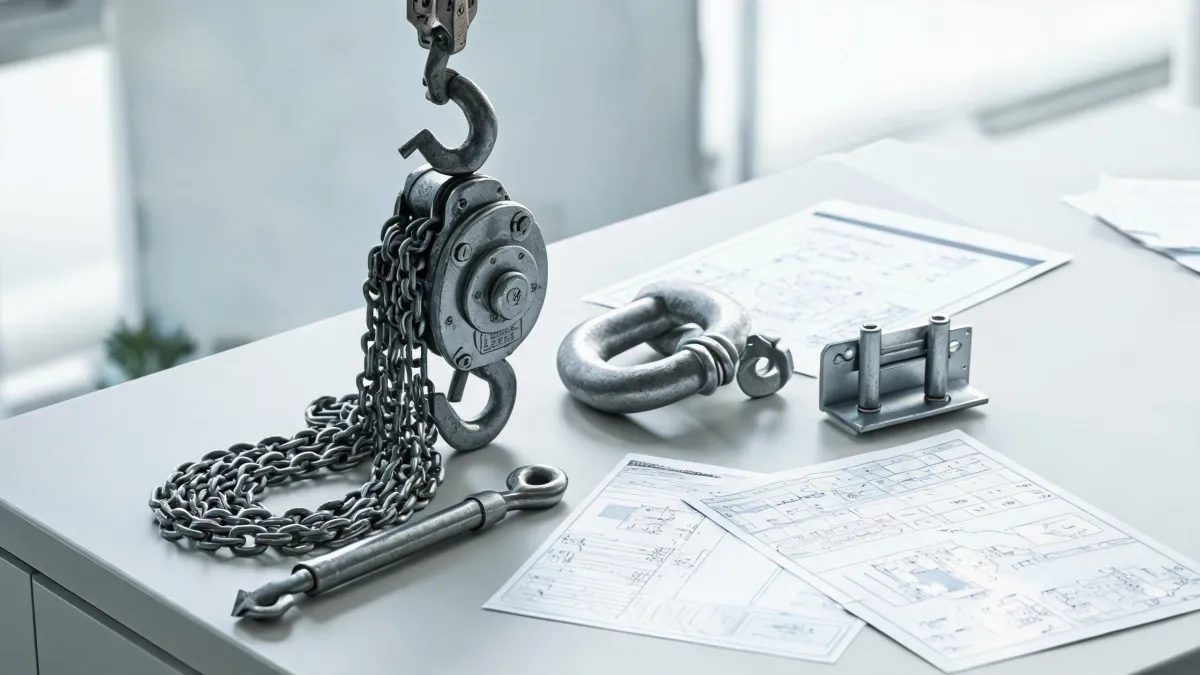
When a storm tears through a roof, the clock starts running immediately. I've handled over 1,200 rush orders in 17 years as an inside sales specialist for manual and electric chain hoists, and the pattern is always the same: a contractor gets the insurance call at 6 A.M., and by noon he's asking me to deliver a hoist by the next morning. Normal lead time might be three days. But nothing is normal after a storm.
Last quarter alone, we moved 47 rush orders with a 95% on-time delivery rate. The 5% that slipped? Almost never the truck or the freight. It was a spec mismatch—the wrong hoist, the wrong anchor, the wrong air compressor—that turned a simple delivery into a jobsite problem.
The roof repair itself—tearing off damaged shingles, replacing decking, re-securing flashing—is the surface problem. The deeper problem is that in the hurry to get equipment on site, the same three mistakes show up again and again. I've seen these on roof jobs in Harrington and a hundred other towns. Here's what they are, and the three-step check that prevents them.
Mistake #1: "Bigger Hoist Means Faster Repair"
When I first started quoting hoists, I assumed bigger was the safe answer. If a customer said "roof repair," I'd quote a 2-ton electric unit and call it a day. Then I watched a crew lose 90 minutes rigging an electric chain hoist to a beam only 12 feet off the ground, when a 1/4-ton manual chain hoist would have taken six minutes to hang.
The number that matters is the heaviest single lift you'll make—not the total size of the roof. On most storm damage repairs, that's a bundle of shingles, a sheet of plywood, or a short run of lumber, all well within the range of a 1-ton manual chain hoist. Our manual chain hoists cover 1/4 ton to 5 tons, and the smaller units are lighter to move around and easier to secure to temporary pick points. Heavier structural steel or mechanical equipment is where the 2-ton and larger electric units earn their keep.
But here's the honest part: if your heaviest lift is 3,000 pounds of steel beam, a manual hoist is the wrong tool. And if there's no reliable power on site, an electric hoist is the wrong tool. The right choice depends on the job—not on what's sitting in the rental yard. If you're using a Harrington hoist, the capacity chart in the manual is where the real answer lives. That's the first thing I ask about before quoting anything.
Mistake #2: "Screw Anchors Just Screw Into Concrete—Simple"
Concrete screw anchors—the screw-bolt style that shows up in a lot of searches when you can't remember the exact name—are great fasteners. They're also the most over-trusted fasteners in an emergency repair. The self-tapping thread feels like a shortcut, and in solid concrete with the right hole size, embedment depth, and edge distance, it is a shortcut. Miss any of those, and a loaded anchor can pull out.
And this is where storm damage gets tricky: the concrete at a storm-damaged jobsite often has cracks, spalled edges, or hidden water damage. The load tables on the anchor's box assume solid, uncracked concrete unless the anchor is specifically tested and marked for cracked concrete. Per FTC guidelines (ftc.gov), product claims have to be truthful and backed by evidence. That's what the load rating on the box is for. It's the number I trust, not the "heavy duty" label on the front.
The question everyone asks is "how much will it hold?" The question they should ask is "what's my substrate, and what's the load angle?" In brick or block, a concrete screw anchor is often the wrong answer entirely—that's where a sleeve anchor or masonry anchor belongs.
Mistake #3: "Any Air Compressor Runs Any Nail Gun"
Let me answer the question directly: yes, a pneumatic nail gun needs an air compressor. But "needs a compressor" and "works with the compressor in the back of your truck" are two different things.
A customer called last month asking whether the 1P1060S would run a framing nailer. That's a 6-gallon pancake-class compressor with a 150 PSI tank, and my recollection is that it's rated around 2.6 SCFM at 90 PSI. Don't hold me to that exact number—check the data plate on your specific unit. That kind of output will probably run a finish nailer or brad nailer all day. A framing nailer is a different story: most list specs between 2.5 and 4 SCFM at 80–90 PSI. On a pancake compressor, you'll sink three or four nails and then hear the pump fight to keep up while you're lining up the next row. In a 48-hour window, standing around waiting is the enemy.
So, do you need an air compressor for a nail gun on a roof repair? If the gun is cordless, no. On a one-off repair, cordless might be the better call—no hoses, no compressor to drag across the roof, less weight on the ladder. If you're already running pneumatics, choose the compressor by its SCFM at working pressure, not by the tank size and not by the big max-PSI number printed on the side.
What a Wrong Guess Actually Costs
In March 2024, a contractor called at 4:41 PM needing a 1-ton electric chain hoist delivered to a jobsite by 6 AM the next morning. We made it happen—rush freight, $380 extra. The hoist arrived on time. But the temporary mounting bracket they bolted to a cracked concrete edge used concrete screw anchors rated for solid concrete only. The anchor pulled out, the bracket shifted, and the hoist had to come down before anyone got hurt. The crew lost nine hours redoing the bracing and the mount. Four guys at $85 an hour is roughly $3,000 in labor—against a $380 rush fee.
The equipment wasn't the problem. The delivery wasn't the problem. The cheapest item in the whole chain was.
I've watched the same pattern with air compressors: a crew grabbed whatever unit was available without matching its output to the nailer, then spent half a day waiting for the tank to catch up. The job slipped past the client's deadline, and a $50,000 penalty clause nearly got invoked. The compressor cost a few hundred dollars. The delay cost the contract.
There's also a detour that wastes more time than it should: searching for the wrong company. If you searched "Harrington Industrial Plastics Tampa," you found a pipe and valve distributor in Florida—not us. We're the hoist manufacturer. These mix-ups happen at least once a month, more after a storm. It's a five-minute detour that, on hour 40 of a 48-hour deadline, matters.
The 3-Step Triage I Run Before Every Rush Order
When I'm triaging an emergency equipment request, I ask three things. Ten minutes of checking now saves a full day on the back end.
- What's the heaviest single lift, and what's the pick point? Write it in pounds, add a 25% safety buffer, then choose the hoist's capacity. If the pick point can't handle the load, the capacity doesn't matter. No reliable power? Go manual. Rapid, repeated overhead lifts? Electric earns its keep.
- What's the SCFM at working pressure, and what does the tool actually need? Compare the compressor's rated SCFM at 90 PSI to the nail gun's listed requirement. If the numbers are close, round up. If the job is small and one-off, ask whether you need a compressor at all.
- What's the substrate, and what's the anchor rated for? Solid concrete, cracked concrete, brick, and block are different worlds. A concrete screw anchor can be the fast, right fix in solid concrete with proper embedment. In cracked concrete or masonry, it's often not.
None of this replaces an engineered repair plan. But when you're under a tight window, these three checks are what separate a 48-hour job from a 72-hour nightmare. I've never once recommended equipment without asking what it's actually lifting, fastening, or driving. There's no "best" tool in the abstract—only the right tool for the specific job in front of you. And after a storm, the right tool is the one that makes the first attempt work. Because after a storm, the roof isn't the only thing that's exposed. Your schedule is, too.

Maren Jorgensen
Maren Jorgensen is an independent hand tool and torque applications analyst covering wrenches, pliers, screwdrivers, hammers, sockets, ratchets, hex keys, and tool sets. She applies ISO 6789-1 torque-tool conformance principles while examining jaw capacity, leverage, fastener engagement, torque range, accuracy, handle geometry, and material hardness. Her practical guides help tradespeople and procurement teams select suitable tools, plan controlled tightening, and compare durability without relying on brand reputation alone.